
Bilirubin Test: Purpose, Significance And What It Measures

Written by Arpan Ghosh
Reviewed by Dr. Ananthakrishnan Chandrasekhar, MD


Key Takeaways

Introduction
The bilirubin test is a vital blood test that helps assess liver function and the body’s ability to process red blood cells. Bilirubin is a yellow pigment formed during the breakdown of haemoglobin in red blood cells. While small amounts are expected in the bloodstream, elevated levels may point to liver disease, bile duct obstruction or certain blood disorders.
Abnormal bilirubin levels often serve as an early indicator of underlying liver or blood-related problems. Understanding why the bilirubin test is prescribed, what the results mean and how it links to conditions such as jaundice can provide valuable insight into one’s overall health.
How Bilirubin Is Formed and Processed in the Body
Red blood cells live for about 120 days before being broken down by the spleen. During this process, haemoglobin splits into heme and globin. Heme undergoes further breakdown, forming unconjugated (indirect) bilirubin, which is not water-soluble.
This bilirubin is passed through the liver, where enzymes transfer it into direct (conjugated) bilirubin, which is water-soluble. The conjugated bilirubin is then transferred into the bile, to the intestines and ultimately to the stool, thus acquiring the brown colour. Some of it circulates in the blood, the quantity of which doctors determine during a bilirubin test.
This collective process is called bilirubin synthesis, and it is important to maintain body balance. An imbalance in this pathway, due to excessive red blood cell breakdown or dysfunction of the liver, causes elevated or low levels of bilirubin.
Understanding Bilirubin Types: Total, Direct, Indirect, and Delta
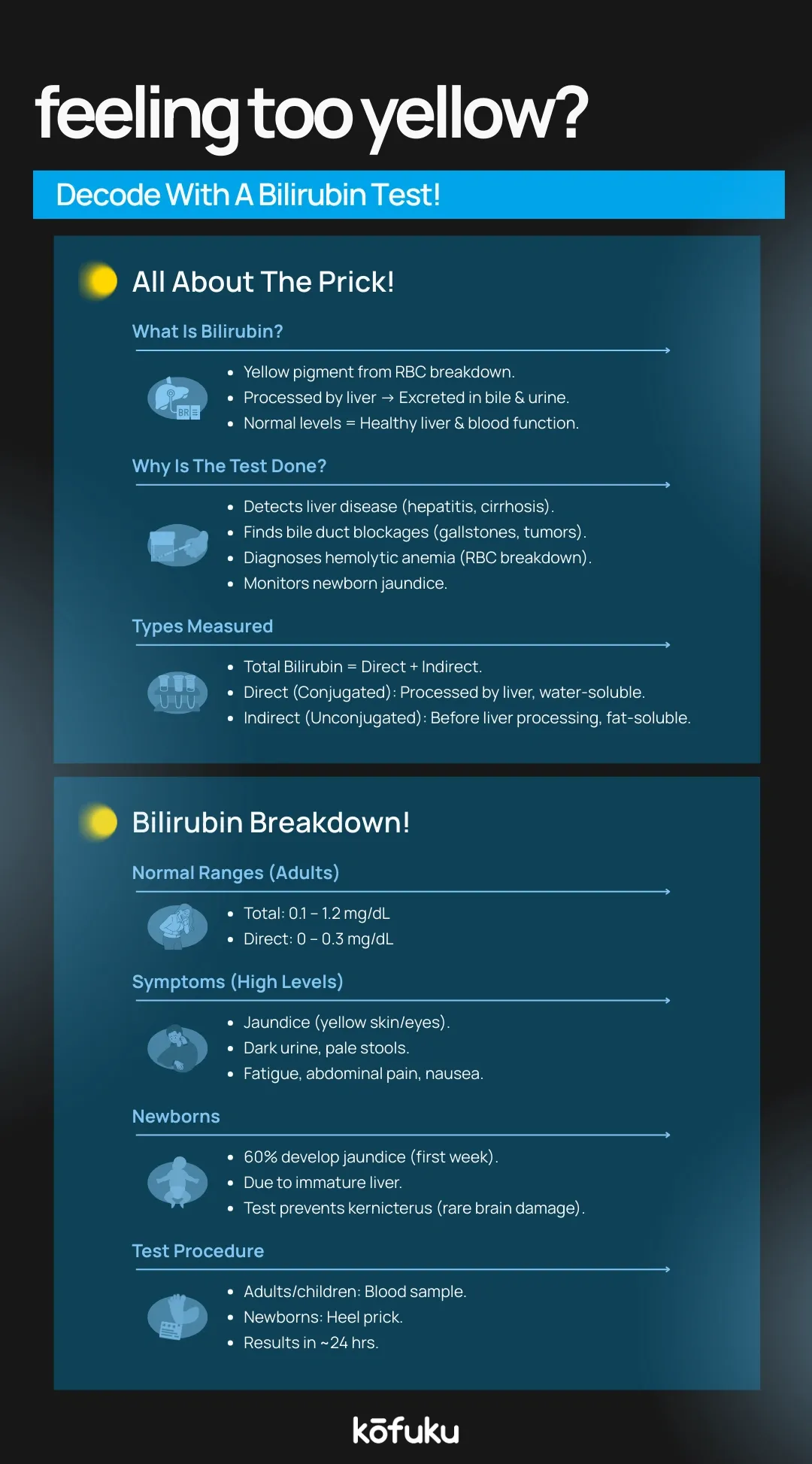
A bilirubin test is not just one measurement. It typically reports four important values:
- Total Bilirubin: This is the sum of direct and indirect bilirubin levels in the blood.
- Direct Bilirubin (Conjugated): Water-soluble bilirubin processed by the liver.
- Indirect Bilirubin (Unconjugated): Produced from red blood cell breakdown before reaching the liver.
- Delta Bilirubin: A less common measurement, delta bilirubin is direct bilirubin bound to albumin in the blood. It is often checked in cases of prolonged jaundice.

Normal Levels and Ranges for Bilirubin in Blood Tests
Like any blood test, bilirubin results are compared against established normal values.
- Bilirubin total normal level (Total Bilirubin level normal range): 0.3 to 1.2 mg/dL
- Direct bilirubin normal level: 0.1 to 0.3 mg/dL
- Indirect bilirubin: 0.2 to 0.9 mg/dL Having a low bilirubin level means patients might have specific nutritional deficiencies or rare metabolic conditions.
Bilirubin Test Results: What Low and High Levels Mean
The significance of bilirubin results lies in how they are interpreted:
- High bilirubin: Suggests liver disease, hepatitis, bile duct obstruction or haemolytic anaemia. In newborns, elevated bilirubin may cause neonatal jaundice.
- Low bilirubin: Rare but can be linked to lifestyle factors like caffeine intake, antioxidant use or certain metabolic conditions. It is generally not concerning, but it should be reviewed by a doctor.
The TSB Test: Full Form and Relation to Bilirubin Testing
Another term often seen on medical prescriptions is the TSB or Total Serum Bilirubin test. This is essentially the measurement of all bilirubin in the bloodstream, combining direct and indirect fractions. Tests using TSB are especially vital in monitoring newborns for jaundice, which can be quite risky to brain development in newborns due to high bilirubin.
Bilirubin Test Procedure, Sample Collection, and Preparation
The bilirubin test is very simple. Blood is drawn in a tiny sample through an arm vein. In infants, a heel-prick specimen can be taken. Some doctors suggest that a short time of fasting before the test is advisable to improve the results. Any type of medications, alcohol consumption and recent illnesses should be reported as they might influence bilirubin synthesis.

Cost Overview: Bilirubin Test Price and Jaundice Test Price
Patients often worry about affordability. Fortunately, bilirubin testing is widely available and relatively inexpensive in India.
- Bilirubin test price: ₹150 to ₹500, depending on the lab and city.
- Jaundice test price: Sometimes listed separately, but usually the same as a bilirubin test, covering total and direct values.
Advanced tests that include delta bilirubin may cost slightly more, but overall, these tests are accessible to most patients.
Serum Bilirubin Indirect: Importance in Diagnosis
Measuring serum bilirubin indirectly helps identify whether high bilirubin is due to increased red blood cell destruction or liver processing issues. This is vital in guiding treatment, especially in cases of cirrhosis, hepatitis, gallstones or haemolytic anaemia.
Common Conditions Diagnosed by Bilirubin Tests
Bilirubin tests can detect several conditions:
- Jaundice: Especially in newborns and adults with liver disease.
- Liver diseases: Hepatitis, cirrhosis, and alcohol-related damage.
- Bile duct problems: Blockages caused by stones or tumours.
- Haemolytic disorders: Conditions where red blood cells break down faster than normal.
FAQ
The normal total bilirubin level in blood is generally 0.3 to 1.2 milligrams per decilitre (mg/dL), reflecting healthy red blood cell breakdown and proper liver function.
For adults, the total bilirubin level normal range lies between 0.3 and 1.2 mg/dL. Results outside this range may suggest liver dysfunction, haemolysis, or bile duct obstruction.
A low bilirubin level is uncommon but may be linked to antioxidant use, caffeine intake, or certain metabolic conditions. It usually does not indicate serious medical problems.
Low indirect bilirubin may result from reduced red blood cell turnover or specific metabolic factors. In most cases, it is not clinically significant but should still be reviewed.
Bilirubin forms when red blood cells break down. Haemoglobin separates into heme and globin, with heme converting into indirect bilirubin, which is later processed by the liver into direct bilirubin.
Bilirubin synthesis is the breakdown of red blood cells into bilirubin. It is essential for removing waste from the body and maintaining healthy liver and digestive system function.
The TSB test's full form is Total Serum Bilirubin. It measures the combined levels of direct and indirect bilirubin in blood, helping evaluate liver health and jaundice severity.
Join our wellness community
Have a question or an experience to share? Join the Wellness Corner discussion on Kofuku Social.
Medical Disclaimer
This article is for information only and is not medical advice. Kofuku content is community-driven and complements, not replaces, professional care. Consult a qualified provider before acting on any health decision.
Related articles

Universal Blood Donor and Recipient: Myths vs. Facts

Tests for Food Allergies: Why Getting the Right Diagnosis Matters