
Universal Blood Donor and Recipient: Myths vs. Facts

Written by Shubhechhya Mukherjee
Reviewed by Dr. Pankaj Sharma, MD


Key Takeaways

Introduction
You may have heard that O positive blood can be donated to anyone, or that AB positive blood can safely accept donations from everyone. Misconceptions are widespread concerning universal blood donor and recipient groups in India and most of the world.
But ever wondered why this is the case? Or how true is it? The more realistic and scientifically accurate reason behind them: the compatibility of red blood cells and plasma. Blood transfusion is a medical procedure that saves lives, and its effectiveness depends on the compatibility of the donor and receiver's blood types.
Confusion or misinformation about the universal donor blood group or the universal recipient can be dangerous. This blog uses facts to dispel myths and outline why proper knowledge about blood group compatibility is essential.
Which is the Universal Donor Blood Group?
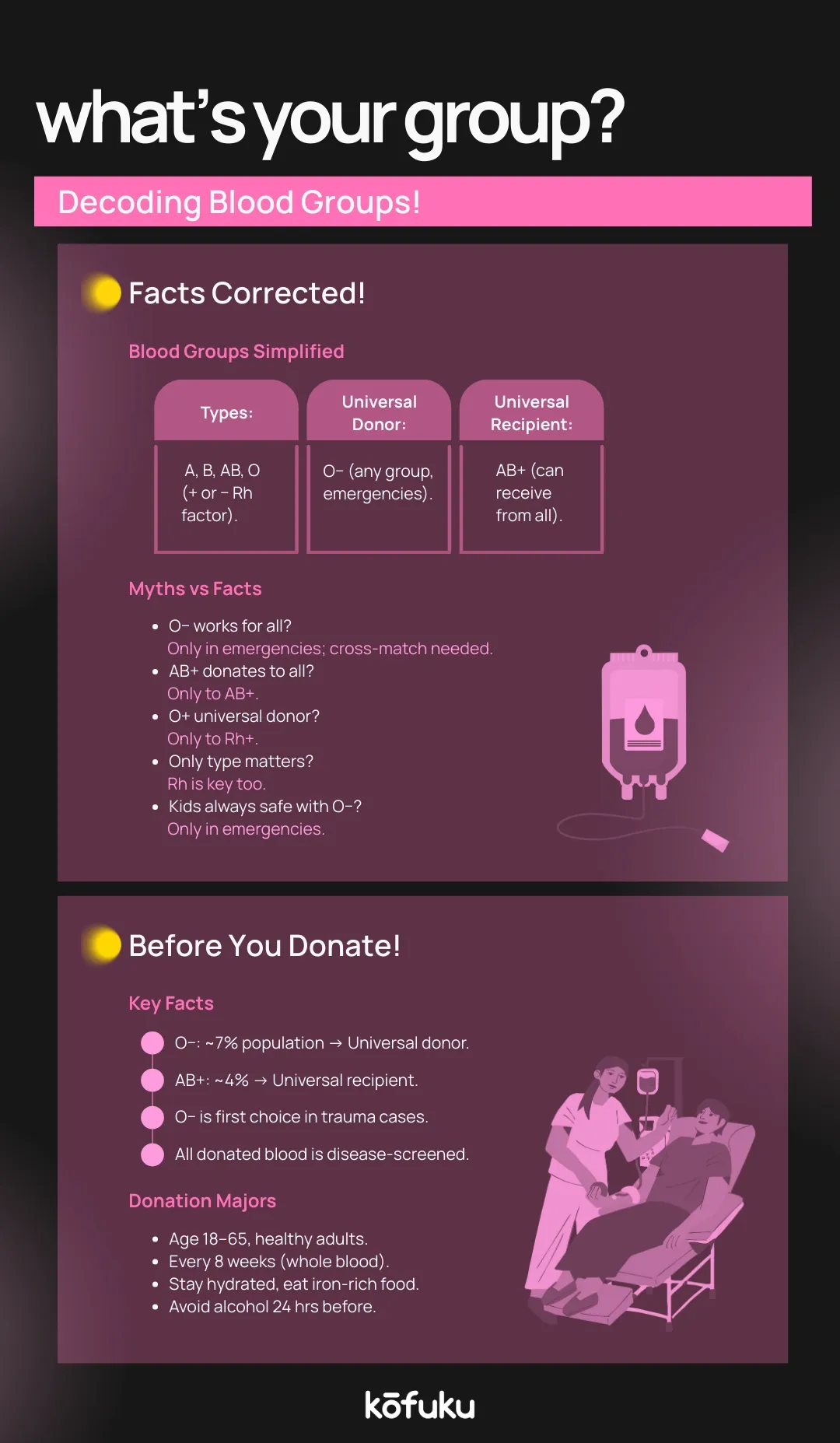
O negative (O-), the blood group is acceptable as the universal donor for red blood cell transfusion, and is universally adopted. This is because O-negative blood does not contain both A and B antigens, the Rh antigen, but has both A and B antibodies.
Thus, in case of emergency, O-negative blood can be transferred to any patient, irrespective of their blood type. Nonetheless, it is essential to note that the O-negative blood type can accept the donations of O-negative people only.
Thus, they are universal donors, but highly restricted recipients because O-negative blood is rare.
Understanding Blood Group Compatibility
The type compatibility of blood is based on the ABO system (A, B, AB, O) and the presence or absence of the Rh factor. It is the combination of these factors that determines who can safely donate and receive blood.
- Group A has A antigens and anti-B antibodies.
- Group B has B antigens and anti-A antibodies.
- Group AB has both A and B antigens but no antibodies, making it a universal blood group recipient.
- Group O has no antigens but both anti-A and anti-B antibodies, making it the universal blood donor blood group.

What is a Universal Recipient?
AB positive (AB+) blood is termed the universal recipient and also called the universal acceptor blood. Individuals of this blood type can accept any other kind of blood since they lack production of anti-A or anti-B antibodies, and the Rh positive factor means that they can receive both positive and negative blood.
Universal Acceptor vs. Universal Donor: Key Differences
Universal donor: O negative (red blood cells only). Universal acceptor: AB positive (can accept any blood group).
The concept of universal receiver/donor is significant; however, in reality, doctors prefer to use matched blood transfusions to minimise the chances of complications.

Is O Positive Blood a Universal Donor?
O-positive blood as a universal donor, which works for all individuals, is a myth. Although O positive can be transfused in any Rh-positive recipient (A+, B+, AB+, O+), the same cannot be done to Rh-negative recipients.
This means O positive is the most in-demand blood type in transfusion services because nearly 85% of the population is Rh-positive. However, it is not a true universal donor blood group.
Why O Negative is Called the Universal Donor?
O negative contains no A, B, or Rh antigens, and as such, it can be used safely on anybody in an emergency. This is why it is also called universal donor group and is stocked frequently in trauma centres and ambulances.
Which Blood Group is Known as the Universal Donor?
The correct is O negative, not O positive, or AB blood groups. This distinction is crucial to avoid confusion during emergency transfusions.
Emergency Situations and Universal Donor Blood
Doctors usually use O-negative blood as the initial transfusion preference in accidents, surgeries, or emergencies in which the patient is of an unknown blood type. After cross-matching, patients will be changed to an exact blood type. Therefore, knowing the universal donor and recipient is not only academic but life-saving and handy.
FAQ
The O-negative blood group is called the universal donor because it lacks A, B, and Rh antigens, making it safe for almost all recipients.
No, O positive is not a universal donor. It can only be given to Rh-positive recipients, not Rh-negative individuals, unlike O-negative blood.
AB positive is the universal recipient blood group because it lacks anti-A and anti-B antibodies, allowing safe acceptance of blood from all other groups.
Only individuals with O-negative blood can donate to everyone. Their red cells lack major antigens, making them the safest option in emergencies when blood type is unknown.
O negative is the universal donor because its red cells lack A, B, and Rh antigens, reducing risks of immune reactions during transfusions across different blood groups.
Universal donor refers to O-negative, safe for almost all recipients. Universal acceptor refers to AB positive, which can safely receive blood from every other group.
Yes, AB positive individuals can safely receive O negative blood since their group accepts all types, and O negative is universally compatible with every blood type.
The AB blood group is the universal plasma donor because AB plasma lacks anti-A and anti-B antibodies, making it safe for transfusion to patients of all groups.
Join our wellness community
Have a question or an experience to share? Join the Wellness Corner discussion on Kofuku Social.
Medical Disclaimer
This article is for information only and is not medical advice. Kofuku content is community-driven and complements, not replaces, professional care. Consult a qualified provider before acting on any health decision.
Related articles

Tests for Food Allergies: Why Getting the Right Diagnosis Matters

How Healthy Is Detox Water? Understanding Its Benefits and Popular Myths